Showing posts with label bee. Show all posts

12 March 2011

a red carpet for royalty

Looking great at the moment are two forms of Red Deadnettle, Lamium maculatum, that have already been in flower for a month, if rather shyly at first.  Now the weather has warmed and days have lengthened they are really getting into their stride and they make a great welcome for early emerging  queen bees.
The first, under the Great White Cherry tree has foliage marked with a bold stripe of silver and good  purple/pink flowers (stronger than shows in these photos).  It is vigorous and has spread from a small plant new in last year to make a carpet over a metre across.  Under the cherry it gets phenomenally dry in summer but this didn't turn a hair and looked good right through.
The other in the bed to the left of the gate is plain green with soft pinky/mauve flowers.  
It is monstrously rampant and has filled half the bed in two years, but I just love it's rude health and bold nettle-y-ness.  It spreads across the soil surface (and anything in its way) rooting stems as it goes but is easily pulled out to control its spread.  It is paired with vigorous bedfellows; Geranium 'Claridge Druce' and Symphytum caucasicum, these can hold their own but the Pheasant Tail Grass is now at risk.  Newly planted in this bed over winter are a range of shrubs and, with the grasses out, I see the other three carpeting the ground beneath them.  This may work.
The usual forms of Red Deadnettle found in the shops are much less vigorous and not so tolerant of drought.  Some have completely silvered leaves and white flowers and they are very pretty, but I find they shrivel in the heat of summer and eventually collapse from the debilitating effects of the powdery mildew that attacks them in dry periods - a couple of plants hang on in sheltered spots but never really get going.  Our two toughies were grown from seed from Umbria, Italy, and both laugh at drought and remain untouched by mildew.  They will be full of early bees in just a few weeks - keep an eye out for the long tongued and charmingly named Hairy-Footed Flower bees that just go wild for the nectar rich flowers.
Of course the first queen bumblebee to emerge found comfrey flowers more to her taste - but then she was probably somewhat perturbed to be chased about by a camera wielding gardener.  
Damn those paps! 


6 August 2010

going global

The lack of rain over the past few months has resulted in many of the best sources of nectar drying up, quite literally, as plants have put their energies into quickly setting seed rather than continue the show and new buds have withered.  Such is dry gardening in a dry season but thankfully there are a few species that are reliable sources of nectar late in the season no matter how dry.  

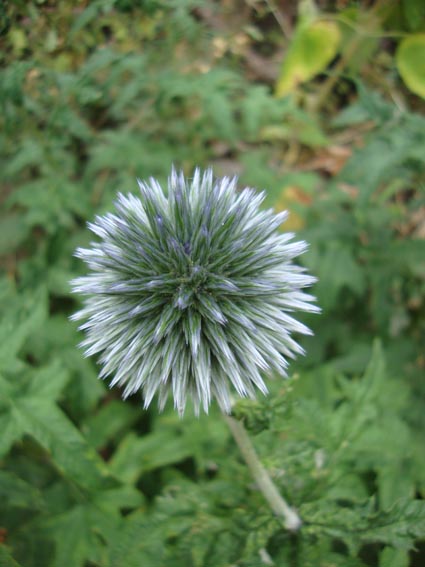
The Globe Thistles, Echinops sp. are bee magnets when they come into bloom in late summer.  The plants growing here were grown from seed randomly pocketed on a garden visit somewhere so I am unsure of their parentage but they are little different from the rest - 1.5m high, rough, thistly foliage and blue-grey flower heads in perfect globes.  There are named varieties in confident clear shades of blue and silver, some tall giants and some of compact growth but in the main the Globe Thistles are all similar with relatively minor differences.  They are adapted to grow with minimal summer rainfall and have deep tap roots to reach any remaining moisture down below.  The early season growth rapidly produces strong clumps of coarse white-backed grey-green leaves, they aren't the prettiest and can become rather tatty over a long dry summer, but by then the exciting spiky satellite buds are forming so who would care?  
The heads are made up of lots of individual flowers and as they open the bees, big and small, gather.  First on this flower is a small male White Faced Bee.  He's feeding, but also waiting for a hungry female to arrive, ripe and ready for ravaging.
When the bumble's get in on the act there isn't much room for the smaller bees and their randy antics, this trio of circumnavigating workers stamping about have probably spoilt the mood and they have it to themselves.  

After flowering and setting seed the heads are disappointingly short lived, there are no winter silhouettes to be had from these.  When they fall apart and the leaves become increasingly disgraceful I will simply chop them down.  They won't mind at all and neither will I.

20 July 2010

blackcurrant sage and thieving bees

I made a prediction earlier in the year that the most asked question come summer would be "what is that bush with those red flowers?".  I was right, but then it is the same each year and I know that "those red flowers" are winners.
To answer the question, it is Blackcurrant Sage, Salvia microphylla.  Growing into a loose mound of rather brittle stems, a metre high and across, and covered with bright red flowers from May to December it is a great plant for a well drained position.  There are a number of varieties available, this is, I believe, 'Kew Red'.  All are very tolerant of drought and poor soil and while preferring full sun seem quite happy in part shade.  Supposedly they are not very hardy but do come through most winters unharmed (but only if well drained).   The older stems protect the heart of the plant from the worst of the frost so I cut them hard back in spring only after growth has started - before winter can be the death of them.  Unpruned they grow much wider and untidier.

Native to Mexico, it has evolved flowers perfect to be pollinated by hummingbirds - the anthers and stamens protrude from the top of the flower to dab on, and take off, pollen from their feathered  foreheads.  Here it proves a surprisingly good source of nectar for bumblebees, surprising because the beakless bees cannot reach the nectar from the front of the flower, their tongues aren't long enough and the flower is tight-lipped.

To get round this the bees bite small holes halfway down each bloom and they feed from the flowers without pollinating them in exchange.  It is interesting that all the holes seem to be gnawed into the right hand side of each flower and that the hole maker isn't the only bee to use each hole, many bees will visit each prepared bloom and fly directly to the hole to feed - obviously the nectar guides, the markings on flowers that are visible in the ultra-violet spectrum that bees use, are ignored as unnecessary and they don't waste time trying the front door.  Sneaky thieving bees. 

9 July 2010

fissle fan

I am a big thistle fan.  I like their big fat rosettes of spiny leaves in winter.  I like their unapologetically pushy growth in spring.  I like their open angular structure and their un-pickability, but most of all I like their shaving brush flowers in violet and mauve.  I am told all too often by visitors that they are 'weeds, weeds, weeds', but this falls on deaf ears, generally they are not too weedy for our purpose (though one is) and the benefits outweigh any difficulties.

The garden is home to three species of thistle, two biennials and one rampaging perennial.  All are good plants for wildlife and the flowers in mid to late summer are a treat for bees and butterflies.

The Musk Thistle, Carduus nutans, is a spiny whopper growing from a big over-wintering rosette to 1/1.5m.  The candelabra of branches needs no staking and each branch ends in a single fat 'artichoke' bud armed with ferocious spines.  The buds open into great big violet brushes - perfect bee-beds for bumblebees to nestle in.

Spear Thistle, Cirsium vulgare, is less statuesque and only grows to 1m here.  It has finer spines and narrower leaves, this gives a lighter feel to the plant.  The round, densely spined buds open into pale violet pompoms over a long season.

Both of these produce lots of seeds that spread on thistle-down parachutes.  This could be a problem in some gardens.  I find that here, with seed hungry birds and an army of molluscs munching away seedlings and with lots of competition for space in the beds they only manage to reproduce themselves enough to please me.  They are easily removed if needs be.

The Creeping Thistle, Cirsium arvense, is the bad penny in the bunch.  It is fiercely invasive, spreading far and wide underground - the roots can go down metres and spread yards in a single season - and it seeds like crazy.  Unbranched relatively spineless metre high stems are topped with clusters of small undistinguished mauve flowers - bees love them none the less for this - but the stems have weak ankles and they often fall over before flowering.  In spite of the potential for it to take over it is a foodplant for a number of species - fat-legged beetles develop inside its stems - so it just earns a place.  I try to nip off the flowers before seed is shed to prevent it's spread and the colony is restricted to the wildlife area and walnut mound by the regular mowing of the grass around it.   

I am a thistle fan.  

I like their spiny violet ways and the summer squeals from bin-users caught an unwary jab in the back of the hand.  Can you see licky bees in powder puff happiness and tell me you're not a fissle fan too?


10 June 2010

the eyes have it

I think ox-eye daisy are irresistible.  I am not alone in this.  The flowers are constantly busy with any number of small things going about their busy business.  A quick walk round the garden reveals why they are right at the top of my must-have-for-wildlife plant list.   

A mining bee,

and a greenbottle make the most of the open faced flowers.

Harlequin ladybirds, in 'mostly black'

and 'traditional' forms, hunt for aphids on the heads.

Tiny white-faced bees feed from the flowers - males also patrol and unceremoniously mate feeding females, the violation doesn't interrupt their meal. 

When downtrodden or flattened by bags, snails will get to work to graze the open florets.

Ox-eye daisy, Leucanthemum vulgare, a common wildflower, will grow anywhere with good drainage and some sun, are reasonably drought tolerant - they grow here unwatered on broken brick filled gabions - and they flower for a long season.  If they have any faults in a garden it is that they will grow far too lushly on rich soil and collapse messily.  They are better in spartan conditions.  They are short lived and easily succumb to bossy neighbours but they will move around a garden by seeding into any suitable places and here have designs on conquering the paths where there is little competition.  Of course left here the flowers would be crushed underfoot so in early autumn I rip up the plants, tear them to pieces and poke the bits into any spare corners.  They will all take and be flowering by the following summer. Well done them! 

21 May 2010

bee but no bumble

Since the earliest flowers opened at the end of winter there have been bees busily working the flowers in the garden.  Lots of small glossy black bumblebees and lighter coloured, hairier ones and I was stumped as neither  appeared on the bumblebee ID chart.
Watching the black bees feed at the flowers it was obvious what extraordinarily long tongues they had, perfect for the tubular flowers of the early comfrey, and the pollen baskets on their back legs stood out bright orange.  The lighter coloured ones were patrolling territories around patches of flowers, just like Wool Carder bees, but instead of pouncing on intruders aggressively as these do it was clear they were intent on mating with the black intruders - Wool Carders don't appear until June and I was confused.         With these characteristics noted an internet search followed.  
Turns out they are not two species of bumblebees at all but instead are Hairy Footed Flower Bees, Anthophora plumipes.  Aside from their lovely name I discovered they nest in holes in walls and other cavities, constructing cells from particles of soil, prefer deep-throated flowers and defend themselves with their large and hairy middle feet (love that!).  The lighter coloured males do patrol flowers on the look out for willing females but they don't chase off other species - though they will try it on with them.  I read they are easily recognised as not being bumblebees by their colour - there are no black bumblebees, by their flight pattern, quick and full of stops and starts - bumblebees fly slow and steadily, and by the shrillness of their 'buzz' (this last seems rather subjective, for me a buzz is a buzz).  
Here is a male, shrilly buzzing as he feeds on blue comfrey flowers.
They will all be gone soon until next year as they only fly from March to late May, wisely leaving the scene before aggressive Wool Carder males appear eager to club them to death with their spike-pronged tails.  Can't say I blame them.