Showing posts with label drought. Show all posts

9 November 2010

autumn daisy exotica

Autumn is a well known daisy season with displays of the herbaceous prairie daisies; aster, helenium, helianthus, stealing the limelight in many gardens.  The majority originate from moist meadows with deep rich soil and in the main do poorly here - the garden is just too dry.  For autumnal daisy-ness here I have been enjoying for weeks the re-flowering of two exotic shrubs from South Africa, the Kingfisher Daisy, Felicia amelloides, and the African Bush Daisy, Euryops chrysanthemoides, both coming into flower after the first rains of autumn.    


The Kingfisher daisy is a small sub-shrub about a foot high and it makes a loose sprawling mound covered with bright blue, yellow-eyed daisies over a long period.  It is sold for summer bedding and hanging baskets and will flower throughout summer if it stays regularly moist and is dead-headed frequently.  Here it grows in a tub with a blue fescue grass and some tree sedum, Sedum praeltum, with stone filled rubbish soil and never receives enough water to keep on flowering. I don't mind when it  shuts up shop at the start of summer as I know it will freshens up when the weather cools in autumn just when the intense blue flowers will be most admired.  It is not fully hardy but has been growing outside here for five years, no doubt the dry, free-draining tub helped it with the freezing temperatures of last winter when others growing in heavier soil elsewhere in the garden turned up their toes.  Easily rooted from cuttings they are good doers in sunny containers.   


(my camera doesn't 'like' blue in low autumn light - they are much brighter and a purer blue than they look here).

Migrainingly intense in bright summer sun the large yellow daisies of the African Bush Daisy seem to my eye to be better suited to the grey days of autumn - not that I have any say in the matter as they flower non-stop except when too cold or too dry.  Another plant sold as disposable summer bedding they will make permanent shrubs in sheltered, well drained sites.  It is incredibly drought tolerant when established as you would expect with its South African roots (few plants can sit unpotted and forgotten  under a bench all summer to grow away untroubled when finally planted - this can) it is also surprisingly cold-hardy, only showing its displeasure in winter by flushing an unhappy bronze (which is rather attractive anyway).  


The largest bush at the Phoenix has made a big dense mound six foot across and nearly as tall in five years.  In full flush it will be covered in hundreds of 6cm flowers.  To keep it tidy I deadhead as best as I can (it is tiresome), without this attention it will still flower on and on but it does get annoyingly messy.  Deadheading  involves snipping each separate flower head off at the base of the stalk.  If the heads are just pulled off the stalks remaining dry to knuckle-stabbing sharpness and you will have pin-cushion hands next time you go in, if you shear it the new buds growing beneath get snipped off too, so it must be one by one but it is worth the trouble.
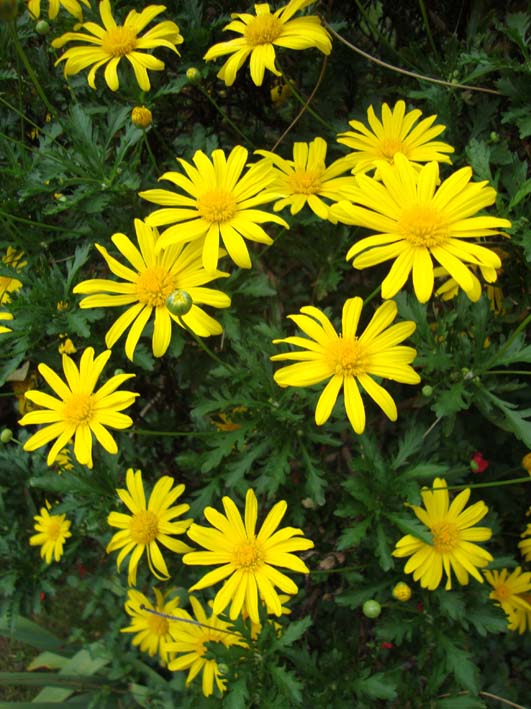

These bushes have been repeated through the garden for their reliable, if brassy, flowering and lumpy mounded forms and they visually tie the garden together, particularly at this time of year when they glow in the low autumn light.  


These two daisies may be far flung from their exotic beginnings but they are good doers in this city garden.  Grow them.  

time to plant

and it should take time.

Gardening atop rubble at the Phoenix means new plants can struggle to establish in the summer-dry conditions so we try and tip the balance in the plant's favour with proper planting at the right time and in the right way.  Now the soil is moist with autumn rain it is the perfect time to plant as the roots can get well established long before the soil dries out again next summer.  Few plants will make it here if just plonked in and summer-dry gardens are unforgiving of corners cut at this point. To give the best chance of survival I am particular in how we prepare the planting holes and time taken doing this now is time well spent. 

Here Peter is clearing a space between a clump of Geranium x oxonianum and the comfrey, Symphytum caucasicum, to dig a hole for a Daisy Bush, Euryops chrysanthemoides.  These are both greedy bullies and it would be no good tucking anything in tightly between these thugs so an area 3ft across cleared of their roots is needed (established, the Daisy Bush will stand above them both and be able to hold it's own).  
Even without such nasty bedmates to contend with a planting hole needs to be at least twice the size of the new rootball to give room for the new roots to grow.  This is especially important on compacted soils.  It can take some doing.  

Here, having cleared a good space of ivy root, Pauline gets to loosening compacted rubble with a steel bar, to plant...

this too-long-in-the-pot and rather leggy, Buddleja officinalis - early flowering, drought tolerant and borderline hardy (more on this no doubt if it gets through the winter).  


From a hole twice the size of the pot came this collection - to add to the ever-growing pile of rubble by the office.  


[Remember, most plants don't mind growing in stony soils and the roots simply grow around any rocks or stones, which makes sense, 'the wild' not being stone free.  We simply remove those that physically prevent the planting hole being dug - if we took out more the garden would sink dramatically!]


The soil is dug out into a barrow or bucket - much easier than dumping a heap on the ground amongst other plants.  It is always surprising how much soil comes out of even a small hole - Pauline's plastic barrow is bulging! 

The excavated soil is always mixed with a couple of shovel-loads of compost, compost holds moisture in the soil, provides nutrients and brings the soil to life around the new plant and it good as guarantees success.    The plant goes in the hole at the same level it was growing in the pot - deeper and the now-buried stems can rot.  The compost-improved soil is filled in round the rootball bit by bit, firming well as we go.  

I always go on and on about firming the soil AROUND the rootball and not the rootball itself - all too often a vigorous firming on top of the rootball produces a tearing sound as the roots are ripped off the plant.  This obviously defeats the object.   We aren't looking to push the plant down into the centre of the earth, it should be at the right depth already (if it isn't take it out and dig a bit deeper!), just firming the in-fill with steady pressure using your knuckles will be enough to remove big spaces and to hold it firm while it roots (taller things, that the wind will rock, will need staking).  

I get asked how hard to firm.  I say "firmly".  This means it shouldn't hurt you or the plant.  I dislocated my thumb a couple of years ago firming - now that was definitely too hard!  


Then we water.  Properly. A whole can for each plant, sometimes two.  This takes time to soak in below the rootball so we don't rush.  Deep watering encourages the new roots to grow deeply as they follow the moisture down.  They will need to root deeply as they will only get another can or two next year as they establish but otherwise will receive no additional watering.  Ever.
  

After watering the plants get a good layer of mulch.  This prevents moisture being sucked out of the soil by the wind and competing 'weed' seeds from sprouting like cress.


Finally we pose (to order) for the camera and repeat the magic words - "Grow you bugger!".  

[Peter is a Phoenix Garden stalwart and has moved tons of rubble up and down the garden uncomplainingly during the renovations of the last few years with little chance to green his rubble-worn fingers.  Looks like he relished the opportunity to repeat the magic words!)  


6 August 2010

off with their heads

In times of drought it can be somewhat wearying to watch as plants, left and right, become increasingly dishevelled.  Without readily available moisture they are unable to put on much fresh growth and flowering often ceases as they try simply to stay alive.  In a normal year many early flowering herbaceous plants benefit from a mid-season cutback to remove congested old flower stems and encourage fresh regrowth, but in a droughty season this is also a useful technique to ensure they survive until better times.  Cutting off all the leafy growth above ground reduces the amount of moisture the plant needs so instead of dying the plant will regrow from the base when conditions improve.  It can take a hard heart to savage a treasured special but if you keep in mind that the buds shrivelling on the plant won't open this season anyway it becomes easier to steel the nerves for a severe chop.  Keep in mind that this way they will next season.
Here is a collapsed Geranium 'Claridge Druce'.  It has flowered and fed the bees for months.  It is tough as old boots and will survive the worst the garden can throw at it but now it has become a mass of sprawling seedheads, and frankly looks a bit of mess.  I don't need to steel my nerves for this one (it gets this treatment every year), I grasp the stems together in a big clump and chop the whole lot off. 
Which leaves me with this.
I want some quick regrowth to fill the gap - or someone "but I'm not stood on anything" will soon be standing on it - so it gets a couple of buckets of water thrown over it to give it a bit of encouragement. 

In a week it has new shoots coming through,
and in two is making progress, and is clearly visible to the unobservant.
I expect it to be back in flower by the end of the month with no additional watering and it will flower well on into Autumn.

Other plants, not as tough, and cut back to aid their survival have not been watered.  This seems contrary but encouraging fresh growth from these before there is rain will soon see them struggling again to support the new leaves.  Better they wait beheaded and quiet until the overall conditions improve.  

going global

The lack of rain over the past few months has resulted in many of the best sources of nectar drying up, quite literally, as plants have put their energies into quickly setting seed rather than continue the show and new buds have withered.  Such is dry gardening in a dry season but thankfully there are a few species that are reliable sources of nectar late in the season no matter how dry.  

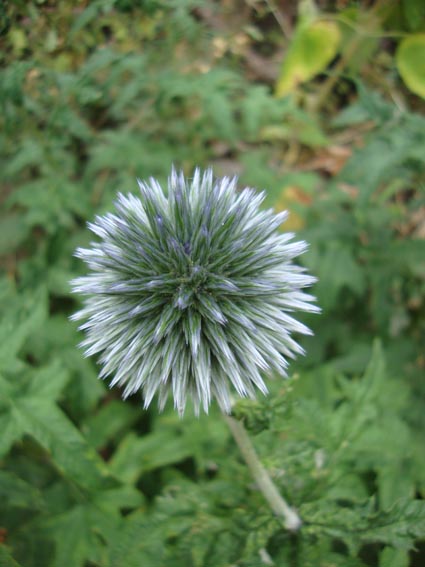
The Globe Thistles, Echinops sp. are bee magnets when they come into bloom in late summer.  The plants growing here were grown from seed randomly pocketed on a garden visit somewhere so I am unsure of their parentage but they are little different from the rest - 1.5m high, rough, thistly foliage and blue-grey flower heads in perfect globes.  There are named varieties in confident clear shades of blue and silver, some tall giants and some of compact growth but in the main the Globe Thistles are all similar with relatively minor differences.  They are adapted to grow with minimal summer rainfall and have deep tap roots to reach any remaining moisture down below.  The early season growth rapidly produces strong clumps of coarse white-backed grey-green leaves, they aren't the prettiest and can become rather tatty over a long dry summer, but by then the exciting spiky satellite buds are forming so who would care?  
The heads are made up of lots of individual flowers and as they open the bees, big and small, gather.  First on this flower is a small male White Faced Bee.  He's feeding, but also waiting for a hungry female to arrive, ripe and ready for ravaging.
When the bumble's get in on the act there isn't much room for the smaller bees and their randy antics, this trio of circumnavigating workers stamping about have probably spoilt the mood and they have it to themselves.  

After flowering and setting seed the heads are disappointingly short lived, there are no winter silhouettes to be had from these.  When they fall apart and the leaves become increasingly disgraceful I will simply chop them down.  They won't mind at all and neither will I.

20 July 2010

blackcurrant sage and thieving bees

I made a prediction earlier in the year that the most asked question come summer would be "what is that bush with those red flowers?".  I was right, but then it is the same each year and I know that "those red flowers" are winners.
To answer the question, it is Blackcurrant Sage, Salvia microphylla.  Growing into a loose mound of rather brittle stems, a metre high and across, and covered with bright red flowers from May to December it is a great plant for a well drained position.  There are a number of varieties available, this is, I believe, 'Kew Red'.  All are very tolerant of drought and poor soil and while preferring full sun seem quite happy in part shade.  Supposedly they are not very hardy but do come through most winters unharmed (but only if well drained).   The older stems protect the heart of the plant from the worst of the frost so I cut them hard back in spring only after growth has started - before winter can be the death of them.  Unpruned they grow much wider and untidier.

Native to Mexico, it has evolved flowers perfect to be pollinated by hummingbirds - the anthers and stamens protrude from the top of the flower to dab on, and take off, pollen from their feathered  foreheads.  Here it proves a surprisingly good source of nectar for bumblebees, surprising because the beakless bees cannot reach the nectar from the front of the flower, their tongues aren't long enough and the flower is tight-lipped.

To get round this the bees bite small holes halfway down each bloom and they feed from the flowers without pollinating them in exchange.  It is interesting that all the holes seem to be gnawed into the right hand side of each flower and that the hole maker isn't the only bee to use each hole, many bees will visit each prepared bloom and fly directly to the hole to feed - obviously the nectar guides, the markings on flowers that are visible in the ultra-violet spectrum that bees use, are ignored as unnecessary and they don't waste time trying the front door.  Sneaky thieving bees.