Showing posts with label thistle. Show all posts

6 August 2010

going global

The lack of rain over the past few months has resulted in many of the best sources of nectar drying up, quite literally, as plants have put their energies into quickly setting seed rather than continue the show and new buds have withered.  Such is dry gardening in a dry season but thankfully there are a few species that are reliable sources of nectar late in the season no matter how dry.  

The Globe Thistles, Echinops sp. are bee magnets when they come into bloom in late summer.  The plants growing here were grown from seed randomly pocketed on a garden visit somewhere so I am unsure of their parentage but they are little different from the rest - 1.5m high, rough, thistly foliage and blue-grey flower heads in perfect globes.  There are named varieties in confident clear shades of blue and silver, some tall giants and some of compact growth but in the main the Globe Thistles are all similar with relatively minor differences.  They are adapted to grow with minimal summer rainfall and have deep tap roots to reach any remaining moisture down below.  The early season growth rapidly produces strong clumps of coarse white-backed grey-green leaves, they aren't the prettiest and can become rather tatty over a long dry summer, but by then the exciting spiky satellite buds are forming so who would care?  
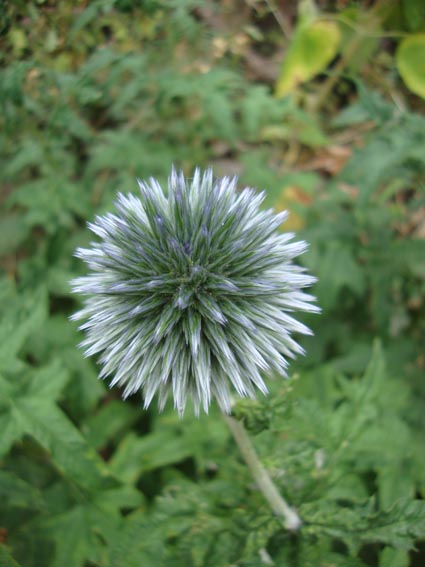
The heads are made up of lots of individual flowers and as they open the bees, big and small, gather.  First on this flower is a small male White Faced Bee.  He's feeding, but also waiting for a hungry female to arrive, ripe and ready for ravaging.
When the bumble's get in on the act there isn't much room for the smaller bees and their randy antics, this trio of circumnavigating workers stamping about have probably spoilt the mood and they have it to themselves.  

After flowering and setting seed the heads are disappointingly short lived, there are no winter silhouettes to be had from these.  When they fall apart and the leaves become increasingly disgraceful I will simply chop them down.  They won't mind at all and neither will I.

9 July 2010

fissle fan

I am a big thistle fan.  I like their big fat rosettes of spiny leaves in winter.  I like their unapologetically pushy growth in spring.  I like their open angular structure and their un-pickability, but most of all I like their shaving brush flowers in violet and mauve.  I am told all too often by visitors that they are 'weeds, weeds, weeds', but this falls on deaf ears, generally they are not too weedy for our purpose (though one is) and the benefits outweigh any difficulties.

The garden is home to three species of thistle, two biennials and one rampaging perennial.  All are good plants for wildlife and the flowers in mid to late summer are a treat for bees and butterflies.

The Musk Thistle, Carduus nutans, is a spiny whopper growing from a big over-wintering rosette to 1/1.5m.  The candelabra of branches needs no staking and each branch ends in a single fat 'artichoke' bud armed with ferocious spines.  The buds open into great big violet brushes - perfect bee-beds for bumblebees to nestle in.

Spear Thistle, Cirsium vulgare, is less statuesque and only grows to 1m here.  It has finer spines and narrower leaves, this gives a lighter feel to the plant.  The round, densely spined buds open into pale violet pompoms over a long season.

Both of these produce lots of seeds that spread on thistle-down parachutes.  This could be a problem in some gardens.  I find that here, with seed hungry birds and an army of molluscs munching away seedlings and with lots of competition for space in the beds they only manage to reproduce themselves enough to please me.  They are easily removed if needs be.

The Creeping Thistle, Cirsium arvense, is the bad penny in the bunch.  It is fiercely invasive, spreading far and wide underground - the roots can go down metres and spread yards in a single season - and it seeds like crazy.  Unbranched relatively spineless metre high stems are topped with clusters of small undistinguished mauve flowers - bees love them none the less for this - but the stems have weak ankles and they often fall over before flowering.  In spite of the potential for it to take over it is a foodplant for a number of species - fat-legged beetles develop inside its stems - so it just earns a place.  I try to nip off the flowers before seed is shed to prevent it's spread and the colony is restricted to the wildlife area and walnut mound by the regular mowing of the grass around it.   

I am a thistle fan.  

I like their spiny violet ways and the summer squeals from bin-users caught an unwary jab in the back of the hand.  Can you see licky bees in powder puff happiness and tell me you're not a fissle fan too?