21 April 2011

return to sandringham - the roof

The first gardening day with Sandringham Court residents was a success so I was looking forward to the second to work on the middle roof.  This is how it looked when I first visited, under-used but great for drying washing - behind me, on other sections of roof (it is big), are a great selection of container plants already planted by residents.  The conditions are the same as most roof gardens; windy, sun-beaten, exposed, so when the residents asked for advice on planting and said they would like a mediterranean theme, I was pleased - plants from mediterranean climatic zones like sun and wind.  
First came the containers.  The same large wooden planters we used at Wardour House.  Big enough to hold a substantial amount of compost and affordable for the number required.  Arriving flat-pack they had been put together ready for the day and after being laid out in position,
the compost could be carried in to fill them.  Each container holds just over six bags each and they  are immovable after filling but they will be stable in strong winds.  We used soil based compost which is heavy so the planters were positioned mainly round the sides and well spaced out to spread the load.  Soil-based compost has more 'body' and supports plant growth over a longer period so is much better for the large shrubs chosen.  
Some could heft the bags easily, 
 For others it was 'many hands make light work'.
The plants were waiting in the residents hall ready for laying out - a selection of drought tolerant trees, shrubs, herbs and bedding plants for quick colour.  I encouraged everyone to have a tea break to give me time to get them out - it is difficult to make plant position choices with enthusiastic audience participation.  Working with the required 'mediterranean' theme one end will be an olive grove with scented foliage plants and blues, yellows and pinks, the other a scented herb garden with purple Cordyline and Phormium to move in the wind.  Once everything was in position everyone got to planting.


Then a break for lunch.  Yet another fine sandwich selection was laid on (bit frozen in the middle,  but nothing a quick blast in the microwave couldn't sort out).
After lunch we worked on the existing roof garden areas to renovate some of the old containers and add some new large planters.  Some of the old root-bound shrubs were released from their bonds and they  will get a new lease of life with root-room and fresh compost around them. 
As there usually is there was one surprise waiting in the wings - lots of the existing containers had broken glass hidden in them, mixed into the compost.  This caused the only injury of the day, a nasty cut finger.  It transpired that this had been added by someone due to a mistaken belief that it prevents slugs & snails.  I took the opportunity to explain that snails can dance along the edges of razor blades so it was not an effective deterrent - I hope the new planters don't get a similar treatment.
Apart from this and someone trapped in a lift with an enormous bamboo plant (fire brigade soon in attendance) the day went very well and this happy biscuit summed up the reaction to the finished 'mediterranean' roof garden.  It was great to see people get straight down to enjoying the garden, to chat. .
and for quiet contemplation.

The finished planters and the plants we used:
Cotinus 'Grace', variegated Phormium, Solanum jasminoides, Pittosporum Tobira.

Solanum crispum 'Galsnevin', Buddleja 'Lochinch', marguerites, silver Helichrysum.

Pittosporum tobira, Senecio 'Sunshine', green Sage, Cistus sp., Miscanthus 'China'.

Cistus sp., purple Fennel, red Cordyline, Buddleja, Pony Tail Grass (Stipa tenuissimma), Rosemary, dark leaved Phormium.

Buddleja alternifolia, Cistus sp., Oregano, yellow Bidens, variegated Phormium.

standard Olive tree, Cistus sp., Erysimum 'Bowles Mauve', Euryops pectinatus, yellow Bidens.

Ceanothus 'Autumnal Blue', purple Sage, Oregano, Geranium 'Ann Folkard', Solanum jasminoides,

Thyme, Lavender, purple Sage, Euryops pectinatus, Erysimum 'Bowles Mauve', Senecio 'Sunshine'.

standard Olive trees with Rosemary and Lavender.

Olives, Lavender, Cistus, Mock Orange, grasses and herbs.
  
dark Cordyline, dark leaved Phormium, purple sage and fennel. 


17 March 2011

goldfinch-a-go-go!

Today I was cut-off midsentence by a squeak of excitement and I was pushed aside.  'How rude!" you might think but I just couldn't compete for attention (understandably, I was droning on) as a pair of goldfinch flew in.   
They chittered and trilled quietly to each other as they searched for seeds among the dried thistle heads in the wildlife area.  These are the first of these beautiful birds we have seen here at the Phoenix and lovely ones they are to add to our birdlist - they're smashing!
Only two rather dodgy pics of their visit.  Here's what they look like elsewhere and not snapped by me.
pic: Lukasz Lukasik

12 March 2011

a red carpet for royalty

Looking great at the moment are two forms of Red Deadnettle, Lamium maculatum, that have already been in flower for a month, if rather shyly at first.  Now the weather has warmed and days have lengthened they are really getting into their stride and they make a great welcome for early emerging  queen bees.
The first, under the Great White Cherry tree has foliage marked with a bold stripe of silver and good  purple/pink flowers (stronger than shows in these photos).  It is vigorous and has spread from a small plant new in last year to make a carpet over a metre across.  Under the cherry it gets phenomenally dry in summer but this didn't turn a hair and looked good right through.
The other in the bed to the left of the gate is plain green with soft pinky/mauve flowers.  
It is monstrously rampant and has filled half the bed in two years, but I just love it's rude health and bold nettle-y-ness.  It spreads across the soil surface (and anything in its way) rooting stems as it goes but is easily pulled out to control its spread.  It is paired with vigorous bedfellows; Geranium 'Claridge Druce' and Symphytum caucasicum, these can hold their own but the Pheasant Tail Grass is now at risk.  Newly planted in this bed over winter are a range of shrubs and, with the grasses out, I see the other three carpeting the ground beneath them.  This may work.
The usual forms of Red Deadnettle found in the shops are much less vigorous and not so tolerant of drought.  Some have completely silvered leaves and white flowers and they are very pretty, but I find they shrivel in the heat of summer and eventually collapse from the debilitating effects of the powdery mildew that attacks them in dry periods - a couple of plants hang on in sheltered spots but never really get going.  Our two toughies were grown from seed from Umbria, Italy, and both laugh at drought and remain untouched by mildew.  They will be full of early bees in just a few weeks - keep an eye out for the long tongued and charmingly named Hairy-Footed Flower bees that just go wild for the nectar rich flowers.
Of course the first queen bumblebee to emerge found comfrey flowers more to her taste - but then she was probably somewhat perturbed to be chased about by a camera wielding gardener.  
Damn those paps! 


11 March 2011

applecatchers

With mulch-hungry apple trees growing atop mounds at the north end and a garden brimming with industrious foraging blackbirds and their backwards kicking digger feet (they amuse me no end but are very messy!) I had been wondering how to keep any mulch in place, so the donation of an enormous bundle of whippy alder twigs from a bout of late winter pruning in Neals Yard (thanks Graham) was synchronicity itself.
With a bit of twine and some lengths of ivy stem the twigs were simply twisted and tied into big twiggy wreaths, dropped over the trees and pegged to the ground with alder pegs - all very woodcraft but with a quick weed around the trees and topped with a heavy mulch of compost they should stop all the mulch being dragged away by the birds.  Ha - the birds can't beat me!
    

10 March 2011

Wardour House Roof Garden

Almost a year ago I visited Wardour House in Soho after being approached by the TA to advise on gardening on the roof space.  This was much underused and as you can see was not all it could be (even so I was wildly jealous having just windowsills myself).  We worked out the budget for the garden so they could apply for some funds and I came up with a plant list for them, suitable for the conditions on most roofs - sunbaked and windswept - and quick growing, the roof is very overlooked and they are keen to gain some privacy. They were awarded a grant from the management body, Soho Housing Association, for the renovations, but building improvements wrapped the block in scaffolding for summer and autumn so we couldn't do anything further until now.
In working out the planting for the roof I wasn't surprised to see at the top of the wishlist were the large specimen plants - bamboos and palms - that everyone seems to want.  I am not an advocate for these as  large specimen plants often struggle to cope with the change of conditions from sheltered nursery to exposed rooftop and can be a disappointment when planted into small tubs that dry out quickly. [bamboos are woodland plants and don't really like droughty exposed positions - palms get tatty and grubby looking sitting dormant over winter, they are much better in hotter climates than ours]
Smaller cheaper plants will usually establish much more successfully than larger and they are substantially cheaper - i'd always go for £4.99 that grows than £100 that doesn't. With a limited budget (or unlimited for that matter) I would always advise that the majority should be spent on large planters and compost - large planters give stable conditions and are slower to dry out  

With the building works nearing completion the residents sourced the largest planters the budget would allow - large planters can be phenomenally expensive but they managed to find these reasonably priced ones online and at 150cmx50cmx50cm they can hold enough soil for good plant growth - 15 were delivered flat-packed along with 80 bags of compost.  Thankfully the end of the works coincided with the delivery and they managed to negotiate everything being taken up to the roof.  I don't think I could have managed  getting all that up all those stairs!
A couple of residents constructed all the planters during the week before the planting day and I accompanied the shopping trip for the plants.  I really do enjoy shopping for 'my choice' plants with other peoples budgets!  The plants bought included a range of Ceanothus, Lavatera 'Barnsley', Senecio 'Sunshine',  Callistemon, Buddleja alternifolia, Escallonia, rosemary, sage and oregano.

The planting day started with arranging the planters on the roof and agreeing on the arrangement - before they were filled (it's too late after!).  This done the containers were filled with 5 bags of compost each.  
It is always surprising how much compost is needed for a large container.
A break for tea gave me time to arrange the plants ready for planting and a chance to enjoy the odd burst of sunshine breaking through.
Planting up the tubs didn't take long...
and everyone got a chance to try their hand...
before posing for the obligatory group photo (the camera shy ran for cover at this point!))
Completed. I think it looks great, but I can see the future when everything has grown...
and before long those lavatera will be head height.  (I can tell no one quite believes this at the moment but at least they are going with me on this -  I shall be proved right come August!)
Well done Wardour House!


sandringham buildings - courtyard - november 2010

Sandringham Buildings is a Soho Housing Association block of 140 dwellings behind the bookshops on Charing Cross road.  The Tenants Association approached us to see if we could help with improving some of the communal garden areas.  The first session was planned to improve two ground level areas; the shady courtyard and an overgrown bed.  The materials and plants had been bought on a shopping trip earlier in the week, using a StreetVan transit van hired for the day was so much cheaper than the charges for delivery into the west end (we must get a designated driver registered for the garden).  The TA had put up notices for the planting day inviting residents to get involve and organised refreshments for the day

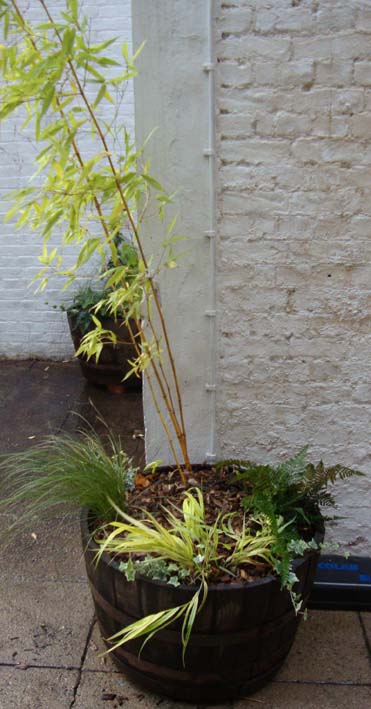
The first area to be tackled was the courtyard.  The existing planting was one large concrete planter with a fern and ivy, an old wash basket planted with a laurel and a few small pots with red-leaved heuchera.  All these were tucked into one corner to make a lone island of green in a large area of paving.  I felt increasing the number of planters through the whole area would look good, the area is in bright shade and all the plants used are tough and reliable in shade to give year round interest, the plants being repeated throughout to give a unified feel.  The TA had chosen half-barrels for the containers - a good choice in appearance and big enough to support good plant growth.  Attractive foliage and form will be the main focus of interest  using ferns, bamboo, sedges and grasses.  Other plants used all have good foliage and flower in season too. 
The courtyard, before.
The containers were put in position and filled with soil based compost - position first as full they are heavy! The plants were laid out in groups for each container and after the first was planted up as a demonstration by me - usual points made; drainage layer, use plant-in-pot to make mould for rootball, plant at same level as in pot, don't firm on top of the plant - then everyone got stuck in. 


 The theme of the planting runs throughout with the same plants repeated but used in different combinations.
Climbing Trachelospermum jasminoides, golden-leaved shrub Leycestreria formosa Aurea,  golden grass Hakenechloa  macra Aurea,  green sedge Carex testacea and Polystichum fern.
A bamboo Phyllostachys bissetti, with spring-flowering Euphobia robbiae,  the sedge Carex testacea, a fern and variegated ivy.
In the planter, variegated bamboo, the sedge Carex testacea, the fern Athyrium felix-femina, late-flowering Anemone japonica, spring-flowering Bergenia and ivy. In the terracotta pot - Pheasant-tail grass Stipa arundinacea, fern Dryopteris erythrosa and ivy.  The small pots of red-leaved Heuchera remain from before. 
Golden bamboo, sedge Carex testacea, golden grass Hakenochloa macra Aurea, fern Dryopteris erythrosa and ivy.
Climbing Hydrangea petiolaris, spring-flowering Brunnera maculata, golden grass Hakenochloa macra Aurea, the tree fern Dicksonia antarctica and ivy.
Phyllostachys bissettii,  Brunnera maculata, Euphorbia robbiae and Stipa arundinacea.

The containers have been spaced out along the wall, each container has had a number of spring bulbs tucked in to give a boost at the end of winter.  At the moment it still looks slightly sparse but come spring everything will soon thicken up.  


From above.  The bamboo should soon establish and fill out to move gracefully in the breeze, softening the hard landscape and will bring this area to life.

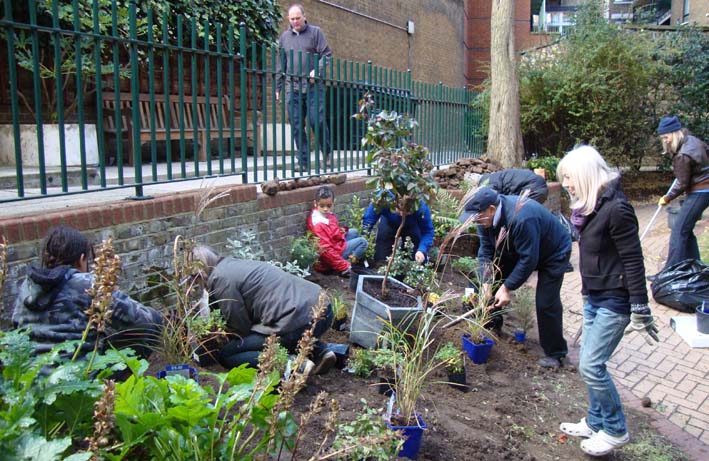
After lunch - a very satisfying spread of sandwiches and the like (well done Sandringham TA!) - we got cracking on the other area - this long bed.  
It gets half a days sun, is prone to drying out in summer and had become somewhat overgrown.  Feverfew, campanula porschyana and a couple of great big Acanthus mollis held their own with nettles and creeping thistle.  After lifting some clumps of feverfew and the campanula (wrapped in plastic bags so as not to dry out) and marking the Acanthus to be retained the area was dug over and as many of the weeds removed as could be.  I had the group go over the area a couple of times to get as many roots as possible out but expect the creeping thistle to be back re-invigorated in spring - then there will be weeding to do.  

The selection of shrubs and perrenials were laid out in their positions, included in the chosen selection are;  Philadelphus 'Belle Etoile', Choisya 'Aztec Pearl', Abelia x grandiflora, Bergenia, Geranium, Miscanthus - more on these no doubt as it gets established.

The planting got underway and was pretty straight forward with just the usual reminders not to plant too shallowly and not to walk on what's already in.  The potted memorial rose for a resident needed to be planted out into the bed, easily done, but on turning it out of its pot, much to everyones surprise, the ashes were revealed in a thick wet layer (remember: pots do need drainage holes!), slightly disconcerting but soon dug in under the rose and in the ground as they should be!  The rose should establish well now the roots aren't sopping wet.  
It soon became apparent that there was an unexpected single-mindedness to remove all the brick rubble in the bed - the bed level went down as the rubble heaped at the base of the plane tree went up (you can see the collection in the background) - after explaining a few times that plant roots don't mind stones and rocks the energies were redirected into planting the bed ... it now even has an unplanned but beautifully constructed gabion and rubble invertebrate habitat at the back of the bed (see what I did there?).

At the end of the day the bed was given a good soak to get everything settled in.  I'm looking forward  to seeing how it gets on come spring as it grows away and makes its mark.
We will be arranging further days with Sandringham residents to work in their garden, and I hope we get such a good turn out on those days.  It was good to see so many people be so enthusiastic about improving their garden space.  Well done everyone!